 photo
by Kay Claybar
photo
by Kay Claybar
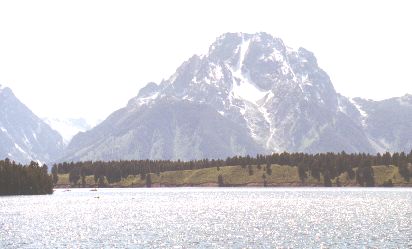
Grand Teton National Park is only a few miles south of Yellowstone, but the topography is miles apart. The valley is called Jackson Hole, and the mountains and the valley frame a majestic landscape of eight large lakes and many smaller ones, glaciers, numerous snowfields, and extensive pine, fir and spruce forests. The Tetons are among the youngest mountains on the continent. Grand Teton rises 13,770 feet!
The 50 mile long, mile high mountain valley (Jackson Hole) is home to the largest Elk herd in America, deer, moose, and the rare trumpeter swan. There are lupine, bluebell, cottonwood, spruce, and virgin stands of aspen. Twisting lazily through the valley is the Snake River, one of cleanest rivers in America.
The "vision" of the Tetons is actually better from Idaho, the back side!
The Episcopal Church of the Transfiguration was built in the summer of 1925 from a suggestion made around a campfire by people who had returned from the long and tiresome trip to the nearest place of worship in Jackson, over 30 miles away. Land was donated by Maude Noble, and Mr. and Mrs. C. B. Voorhis, a lifelong friend of the Bishop of Wyoming, donated the funds to build the chapel. Above the altar is a plate glass reredors window framing the Grand Tetons. The bell at the entrance to the church was cast in 1842 and is from St. Barnabas Church, Irvington, NY. The chapel is open 24 hours a day during the tourist season.
The Jackson Hole Valley is 50 miles long and the town of Jackson is at the south entrance to the park. If you head west from Jackson you cross Teton Pass, which gives you a wonderful view back to Jackson. If you continue west into Idaho and then head north, you get a spectacular view of the Tetons which rivals the view across the lake above. I wish I'd taken a picture, but I was driving!