

"Mix Master Malony"
By Dave Ellis
What do you get when you cross “Blue Nectar” with “Weep Sheep Weep?” Blue Ewe Studios, of course.
There, perched atop one of the hidden hills of Freeland, David Malony records, mixes and masters music for the flux of Whidbey Island musicians who move through his studio like some well-tuned turnstile.
Malony, who has been a drummer for more than 40 years, also plays on some of the albums he mixes, including performances with such island bands as “Blue Nectar” and “Weep Sheep Weep” which led to the studio’s name.
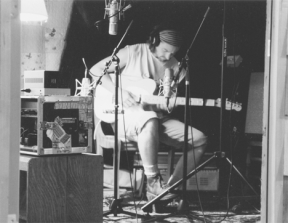
The 1,000-square-foot studio houses a series of isolated rooms with various mics and instruments where each vocalist, guitarist, pianist and other musicians are recorded in a singular room. These soundproofed rooms surround the largest space, where Malony’s drum set sits.
The final room is packed with recording equipment and all the bells and whistles that he needs to pull the sound out of a mix just the way the artist wants it.
Dealing with all manner of artists who make records — from local students from the South Whidbey High School Jazz Band to storytellers to hard rock bands and even monks who chant — Malony said his main purpose is to create something that people will want to hear.
“It’s always been about making the best music; that quest for the best sound,” Malony said. “I want to create that space in the music that draws people in and makes them feel something. So I listen to the artist and figure out what a song is asking for sonically and then try and figure out how to create that.”
Music dominates Malony’s memory of growing up. He played the trumpet at 8 and moved to the drums when he turned 12.
Malony started performing professionally on drums at the age of 18; moving around the country, following gigs and friends, eschewing college to get out on the road and make music.
After years of touring, recording and living the sometimes overwhelming life of a musician, he started to expand his horizons.
Ultimately, Malony decided he wanted to start mixing his own music when he wasn’t able to fully control how his drums would be heard on any given album he was playing on.
His timing was in perfect sync with the digital age when recording equipment became much more affordable.
In some ways, it was a solo journey. Malony’s parents had never encouraged his musical life. And, ironically, even though Malony’s mother never actually heard her son play before she died, her substantial estate helped seed Blue Ewe Studios and send his career down a more specific path musically.
Having had his own less than rapturous experiences with musical engineers, Malony wanted to make a place for musicians where they could feel supported while they made music.
“I feel really blessed to be able to do this,” Malony said.
He got his feet wet mixing his first two albums, both by Whidbey Island musicians; “Mercy Hands” by Tom Hoeflich and Timothy Hull’s “Brambleland.” The two albums gave him the training he needed to pull the best sounds out of the music, he said.
Right out of the gate Malony’s mixes seemed to make a splash.
He recorded four albums for “Junkyard Jane,” including “Milkin’ The Frog,” which won the Best Northwest Recording 2000 B.B. Award from the Washington Blues Society.
The Randy Oxford Band recorded two albums at Blue Ewe Studios and walked away with the Empire Award in 2004 for the Best Blues Album and won the Best Blues Recording in 2005 for their album “All the Buzz” from the Washington Blues Society.
Their most recent album, “Memphis to Motown,” is a finalist in the International Blues Challenge in the category of “best self-produced CD.” Malony will find out if that one’s a winner too, when awards are announced in February.
The roster of musicians who have recorded at Blue Ewe looks like a who’s who of island musical talent.
Janie Cribbs and Joe Reggiatore feel like family having recorded so many albums with him. Other familiar faces include Amelia’s Only Daughters, SisterMonk Harem, Bahia, Steve Jordan, Wired Band and Levi Burkle.
Malony also extends services to the Whidbey Island Waldorf School and has recorded the All Island Jazz Concert, a scholarship fundraiser, for several years in a row.
Malony also creates sound effects and sound design, including music assembly and editing for filmmaker Richard Evans’ “Crimes X2” and for playwright Tom Churchill’s most recent production, “Blue Virgins.”
He is also often seen at local shows manning the sound board for performances or playing drums.
The list goes on and on even though Malony said, from a business standpoint, he should be anywhere but here.
But he said Whidbey Island is the only place since childhood that has felt like home. He moved here in 1989.
“It would take a lot to pull me out,” he said. “This community is so rich and
I get to experience every kind of music.”
The most satisfying thing Malony said is listening to a person and really understanding what they are trying to do. He tries not to impose anything on the music, but rather listens carefully after assembling all the elements of a piece.
“It’s often subtle work and a small change in a mix can make a huge difference. If you stay tuned to that thing in the process and get to that final emotion — then you’ve really done your task well.”
Reach Blue Ewe Studios at 331-3756 or go to the Website at www.blueewestudios.com.
From The South Whidbey Record - July 6 2002
"It's a sound career choice"
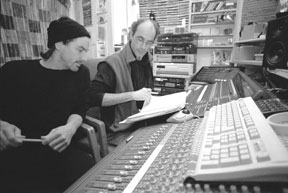
Timothy Hull listens to a playback of a track he just recorded as recording engineer Dave Malony works with the sound digitally. Malony is part of a small community of recording engineers who do their work on South Whidbey.
By Matt Johnson
Lined up on the shelves at Joe's Island Music in downtown Langley are compact discs recorded by a large contingent of South Whidbey recording artists.
The names are familiar -- Derek Parrott, Timothy Hull, Janie Cribbs, Local Buddha. But their recording help is not so much so. Wedged in between the latest worldwide releases from recording industry giants Sony, RCA and Warner Brothers, albums by local bands and musicians get "pressed" under much smaller labels.
Putting the tunes down on compact disc are less than a handful of South Whidbey recording engineers who, for the love of the music, are the bridge between the music of the island and its fans.
Back in the woods and at the ends of rural lanes that are all but invisible to anyone but the locals, small-scale recording engineers are hard at work this summer, doing the final edits on summer releases or getting bands into the studio to get their latest songs on tape -- or as it happens these days -- on the hard drives of computers.
Busy at the mixing boards this summer -- as they have been for years -- are Freeland recording engineers Dave Malony and Robbie Cribbs. A long way from the corporate recording studios in Los Angeles and New York, both men make a living in capturing the music of lesser-known musicians and doing other sound-oriented projects. Working out of a cabin-like structure behind his home in the woods, Malony primarily works with new music in his Blue Ewe studio.
Cribbs, who picked up his trade as a teen growing up in Ireland, has his share of bands at his Sound Trap recording studio, but is also a bit of a digital tinker. The work he enjoys the most has him working at two Macintosh computers and a mixing board putting video clips and audio tracks onto DVDs.
For both men -- even though their methods differ somewhat -- the recording business is about getting the perfect sound out of a performance or a project.
"It's all about the right vibe," said Malony.
It has to be, because South Whidbey is definitely small-time when it comes to recording music. Even so, in his soundproofed recording booth at Blue Ewe, Malony can do pretty much anything a big recording studio can, aside from churning out 5 million copies of a CD. Between his bank of mixing boards, an eight-channel VHS recorder and a bank of digital recording drives, Malony's equipment does the job that 15 years ago required a $25,000 tape recorder and thousands of dollars in other equipment.
After coming to Whidbey Island as a musician 11 years ago and getting frustrated with the cost of recording his own music, Malony dove into the engineering side of the business when he discovered that setting up his own studio would be more affordable. Since then, he has worked with both local and off-island artists to record their music.
Blue Ewe stays busy because Malony makes sure the price is right for each of the artists who record there. Hourly rates are on a sliding scale, Malony said, a scale that is nowhere near the $150 an hour he said some engineers charge.
For Puget Sound area bands like Junkyard Jane, which recorded its last album at Blue Ewe in just two and a half weeks, the price may not be so crucial. But for certain Malony favorites, like Timothy Hull, time -- lots of it -- is a necessary element.
Malony and Hull spent nine months recording Hull's last album, "Brambleland," and are currently several months into another project. During a typical day with Malony, Hull will record the same song several times over as both men search for just the right sound off the guitar and from Hull's voice.
"We go exploring," Hull said.
But only with Malony as a guide.
"The trick for me is to read people and decide what they need," Malony said.
It helps that engineer and musician are on the same team -- something that seems to be a common thread among island engineers. Over at Cribb's Sound Trap, recording projects are almost more fun for the guy in the recording booth than for the band in the studio.
"I get enthusiastic when it comes to people's projects," Cribbs said. "You've got to be doing it for the love of the music."
That enthusiasm is apparently appreciated. One regular client at Sound Trap, a New Zealand musician, happily flies half way around the world to record in Cribb's basement studio.
Cribbs said musicians need close working relationships with their recording engineers to get the sound they want.
"They find someone they're comfortable with," he said.
In his business since 1976, Cribbs spends as much time playing with sound on his own as he does working on other people's music. With the advent of DVDs -- laser optical discs that can record 1,000 times the information possible on a regular CD -- Cribbs has been able to combine video and sound on one medium. While mixing the two has its profitable side when it comes to producing wedding videos with custom soundtracks, Cribb's favorite pieces of work include a Sharon Shoemaker short film called "Audience" he set to music and samples from a poetry reading.
When considering the future of the recording industry, South Whidbey is not so much a struggling outpost as it is an alternative. While the big recording labels will continue to make the big money and the big stars, Malony said local engineers like himself, Cribbs, and a few others scattered around the island, are the "midwives" for music that might not otherwise reach a wider audience than is possible playing in local halls and bars.
While it might be fun to be a garage band, it is the studio, he said, where musicians reach their potential.
"It creates an environment in which people can create music," he said.